Stand outside on a clear night and the sky is mostly black. That sounds too obvious to be interesting. It is one of the strangest facts available to anyone with eyes. Working out why took about three hundred years.
The setup
Suppose the universe is infinitely large, has existed forever, and has stars scattered roughly evenly through it. Pick any direction at all and follow that line outward. It never leaves the universe, because the universe has no edge. Sooner or later it must run into the surface of a star.
That is true of every direction. Every single line of sight, no matter how carefully you aim at an apparently empty gap, terminates on something glowing.
So the entire sky should be as bright as the surface of a star. Not sprinkled with points of light. Uniformly ablaze, horizon to horizon, at roughly the brightness of the Sun.
It is not. This is Olbers' paradox. The gap between the prediction and a glance out of the window is about as large as a gap in physics ever gets.
The answers that do not work
Distant stars are fainter. True, and irrelevant. Brightness falls off as the square of distance, but the number of stars at a given distance grows as the square of distance. The two cancel exactly. Every shell of space at every distance contributes the same total light.
Dust blocks the light. This one is nearly right. It fails on thermodynamics. Dust sitting in a bath of starlight absorbs energy and warms up. Given forever, it reaches the temperature of its surroundings and re-radiates just as much as it takes in. A screen that has come to equilibrium is not a screen.
What actually resolves it
The universe has not existed forever. It is roughly 13.8 billion years old, and light has a finite speed.
That combination puts a hard edge on how far we can see, not because space stops but because time does. Light from anything sufficiently far away has simply not had long enough to reach us yet. Most of those infinite lines of sight are real, and the stars along them may well exist, but the light is still on its way.
The expansion of the universe deepens the darkness. Light from very distant sources is stretched on the journey, dropping out of the visible range and into the infrared and beyond. Some of it arrives and we do not see it as light at all.
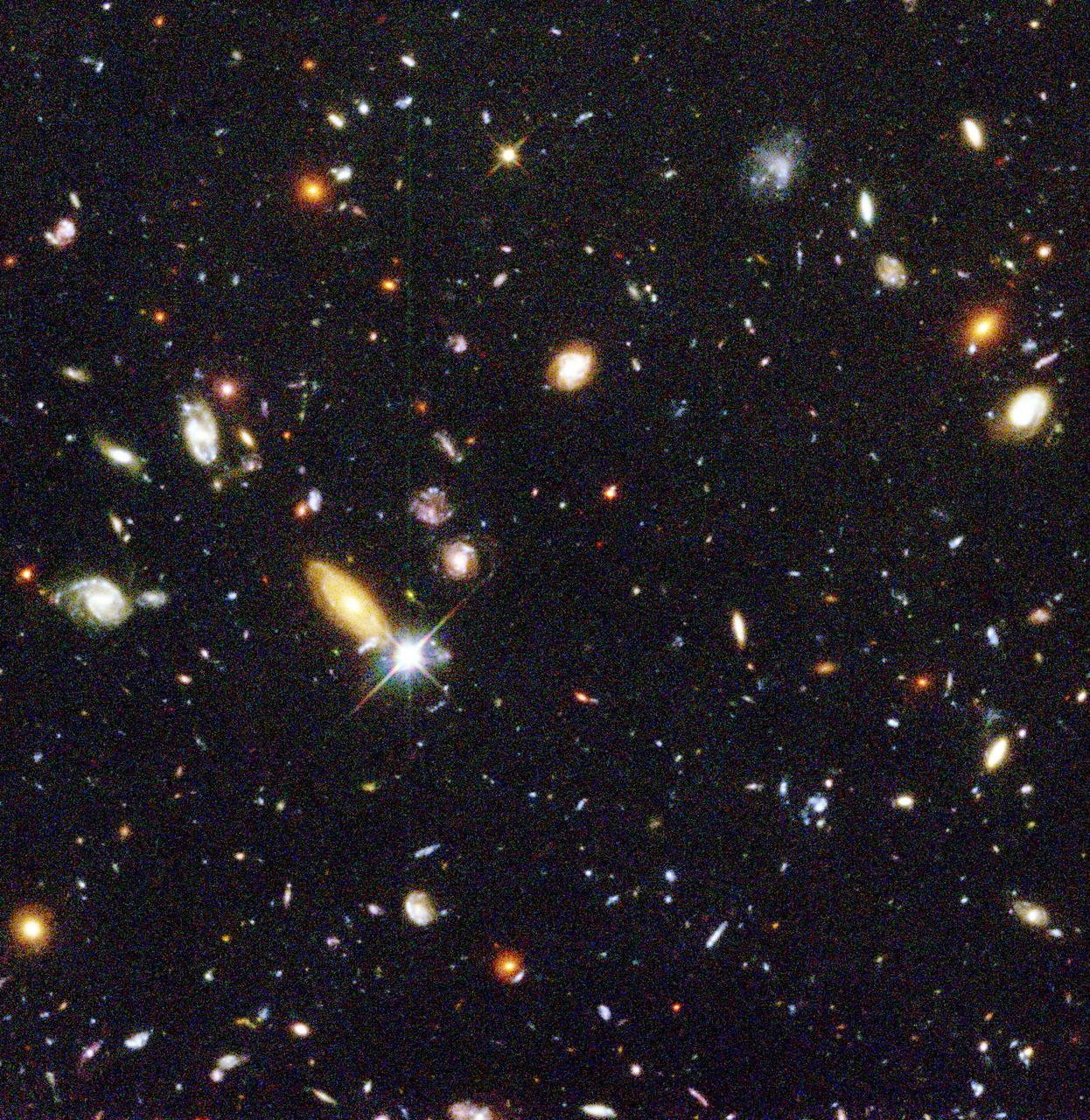
The picture above
That is the Hubble Deep Field. It is a patch of sky that looked empty, roughly the size of a grain of sand held at arm's length, stared at for ten days.
Almost everything in it is a galaxy. Thousands of them, in a gap that showed nothing at all.
And it is still black between them. The paradox, photographed, and its answer in the same frame: point anywhere and there is something out there, but the sky stays dark because the universe has not been running long enough for all of it to arrive.